Marshall Goldsmith; Mark Reiter. Triggers: Creating Behavior That Lasts–Becoming the Person You Want to Be (Kindle Locations 2169-2173). The Crown Publishing Group. Kindle Edition.
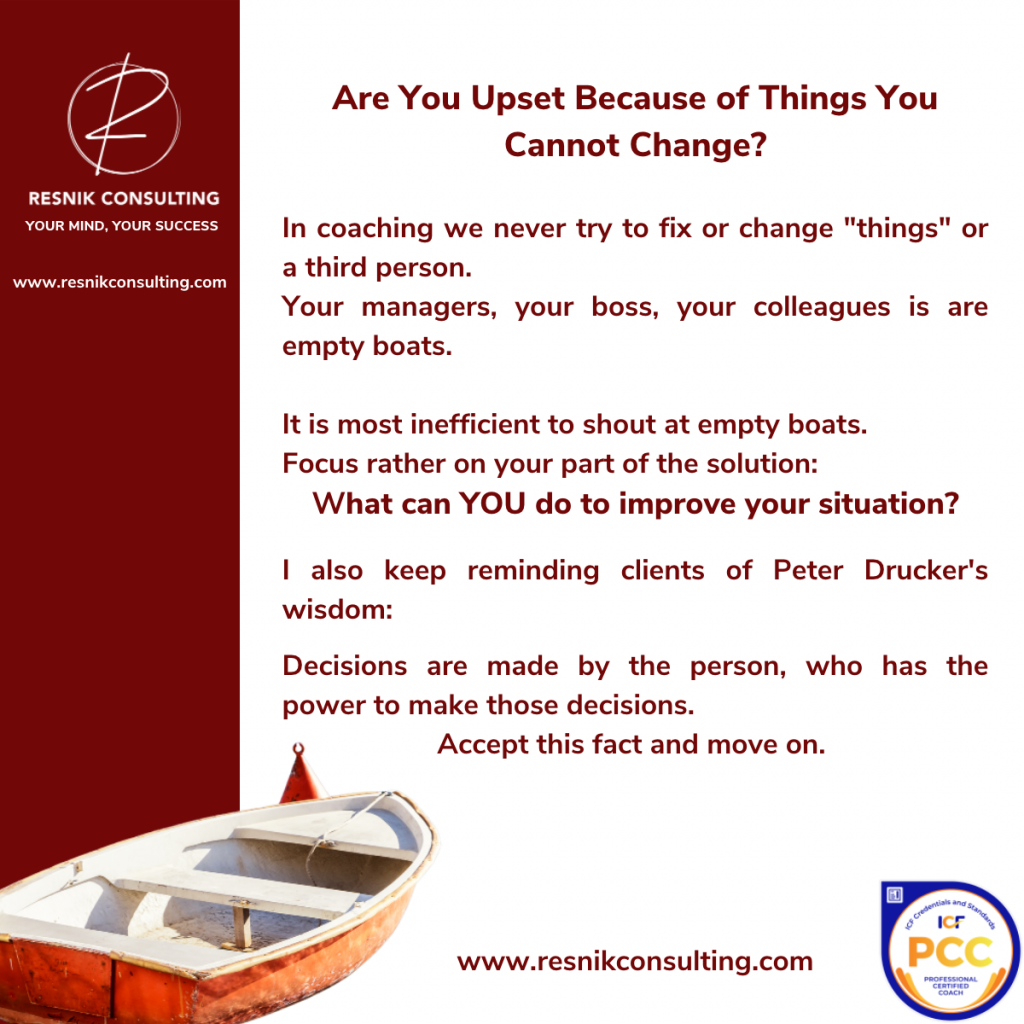
It’s Always an Empty Boat
The Buddhist wisdom is contained in the Parable of the Empty Boat:
A young farmer was covered with sweat as he paddled his boat up the river. He was going upstream to deliver his produce to the village. It was a hot day, and he wanted to make his delivery and get home before dark. As he looked ahead, he spied another vessel, heading rapidly downstream toward his boat. He rowed furiously to get out of the way, but it didn’t seem to help.
He shouted, “Change direction! You are going to hit me!” To no avail. The vessel hit his boat with a violent thud. He cried out, “You idiot! How could you manage to hit my boat in the middle of this wide river?” As he glared into the boat, seeking out the individual responsible for the accident, he realized no one was there. He had been screaming at an empty boat that had broken free of its moorings and was floating downstream.
We behave one way when we believe that there is another person at the helm. We can blame that stupid, uncaring person for our misfortune. This blaming permits us to get angry, act out, assign blame, and play the victim.
We behave more calmly when we learn that it’s an empty boat. With no available scapegoat, we can’t get upset. We make peace with the fact that our misfortune was the result of fate or bad luck. We may even laugh at the absurdity of a random unmanned boat finding a way to collide with us in a vast body of water.
The moral: there’s never anyone in the other boat. We are always screaming at an empty vessel. An empty boat isn’t targeting us. And neither are all the people creating the sour notes in the soundtrack of our day.
• The colleague who always interrupts you in meetings. He thinks he’s smarter than everyone, not just you. Empty boat.
• The aggressive driver who tailgated you for miles on the way to work today? He does that every day on any road. That’s how he rolls. Empty car.
• The bank officer who turned down your small business loan application because of a typo on the form? He sees a form, not you. Empty suit.
• The checkout woman at the supermarket who neglected to pack the small tin of gourmet anchovies you need for tonight’s dinner party, so you have to drive back to the market to pick up what you paid for? She’s been scanning and packing items all day. A three-ounce tin is easy to miss. She didn’t do it intentionally, certainly not to you. Another empty vessel.
I like to make this point in leadership classes with a simple exercise. I’ll ask a random audience member to think of one person who makes him or her feel bad, angry, or crazy. “Can you envision that person?” I ask.
A nod, a disgusted face, and then, “Yes.”
“How much sleep is that person losing over you tonight?” I ask.
“None.”
“Who is being punished here? Who is doing the punishing?” I ask.
The answer inevitably is “Me and me.”
I end the exercise with a simple reminder that getting mad at people for being who they are makes as much sense as getting mad at a chair for being a chair. The chair cannot help but be a chair, and neither can most of the people we encounter. If there’s a person who drives you crazy, you don’t have to like, agree with, or respect him, just accept him for being who he is.
Don Corleone, the Godfather, must have been a closet Buddhist when he said, “It’s not personal. It’s business.” He knew that people disappoint us or disagree with us when it’s in their best interest to do so, not because they want to cause us pain. It’s the same with all the people who annoy or enrage us. They’re doing it because that’s who they are, not because of who we are.